
Generative AI isn’t a future trend anymore, it’s already reshaping how students learn, how employers hire, and how institutions support the entire career journey. Students are drafting CVs with AI, preparing for interviews through chatbots, exploring career paths in minutes, and working in ways that look nothing like they did five years ago. Employers are experimenting with AI too, from sourcing to screening to on-the-job workflows. And while universities are still forming guidelines, Career Services is already in the middle of the transformation.
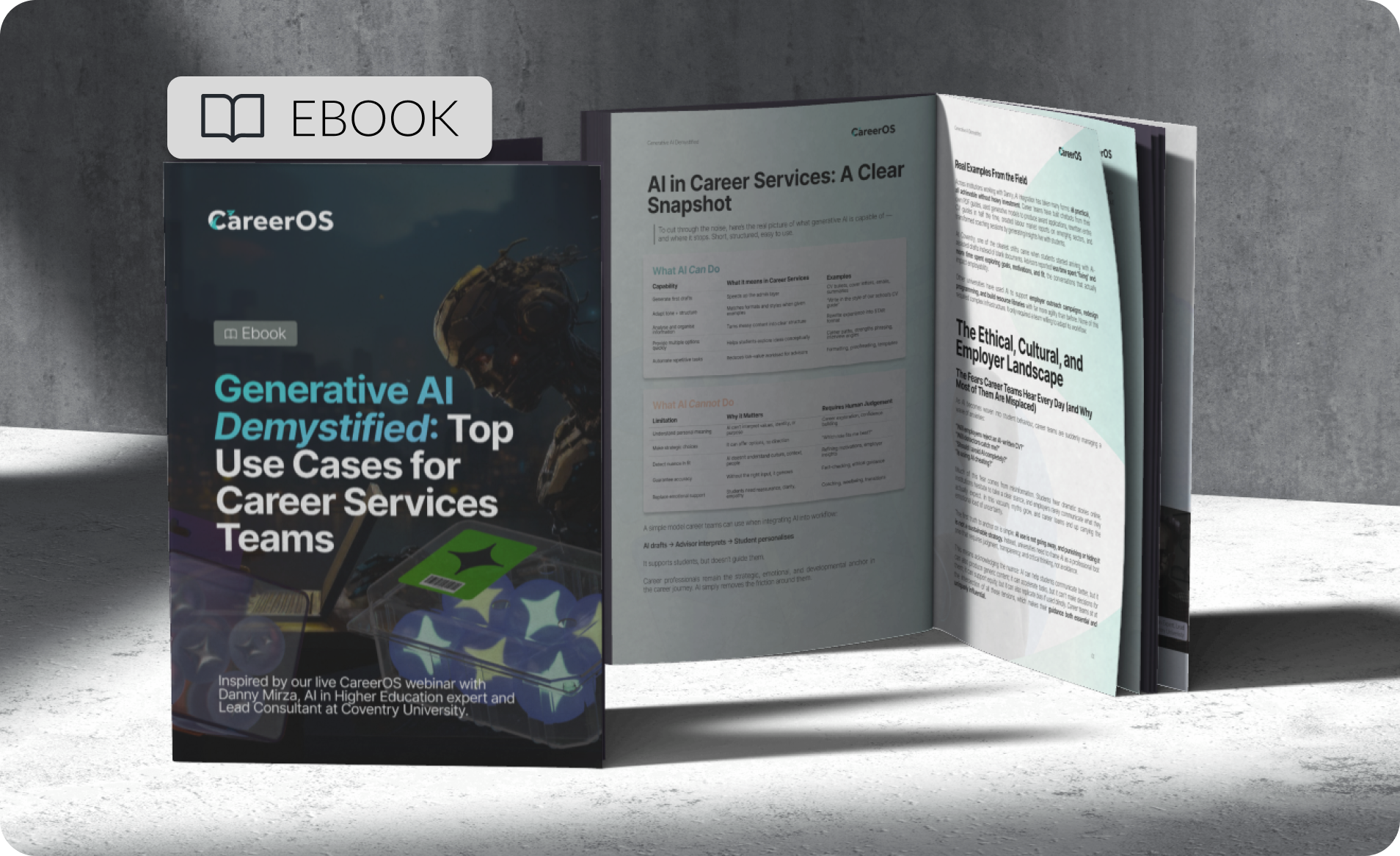
To help career teams navigate this moment with clarity, confidence, and practicality, we created Generative AI Demystified: Top Use Cases for Career Services Teams, a brand-new ebook inspired by our global live session with Danny Mirza, AI in higher education expert and Lead Consultant at Coventry University.
In that session, career professionals from Europe, the US, and Australia came together with one shared question:
“What does AI actually mean for our work, and how do we use it without losing the human element?”
The ebook answers that question head-on.
AI Isn’t Replacing Career Professionals, It’s Upgrading the Way They Work
One of the biggest misconceptions around AI is that it will replace advisors or remove the human touch from career development. The opposite is true. As the ebook explains, AI is excellent at handling the transactional tasks career teams spend too much time on: formatting CVs, brainstorming bullet points, rewriting copy, summarising information.
This frees advisors to focus on what truly matters: the transformational work like confidence building, identity exploration, decision-making, and helping students tell their authentic stories (page 3) .
The AI-First Mindset: Where Real Integration Begins
One of the strongest insights from Danny (and a section we highlight in the ebook) is that successful AI adoption has nothing to do with choosing the “right” platform (page 6) .
It starts with a mindset shift:
- using AI in your workflow
- experimenting without pressure
- reducing admin load
- redefining how sessions flow
This mindset is what transforms teams from cautious to confident.
Three Layers of AI Integration (Simple, Practical, Actionable)
The ebook breaks down AI adoption into three clear layers (pages 6–7) :
- Internal workflow – using AI to speed up prep work, research, and content creation.
- Live in coaching – using AI during 1:1 appointments to accelerate feedback and empower students.
- Self-service student tools – chatbots, guides, and AI-powered helpers built using your own PDFs and content.
This structure removes overwhelm and shows teams exactly where to start.
The Ethical, Cultural, and Employer Landscape
We also tackle the big fears career teams hear every day: AI misuse, employer reactions, and the anxiety around detection tools. The ebook clarifies why AI detectors are unreliable (page 9) , why hiding AI use is the wrong approach, and how employers genuinely view AI-generated applications.
Looking Ahead: Agentic AI and What’s Coming Next
The final chapter explores the future of AI in career development, including agentic AI tools like Manus AI and GPT Operators (page 10), systems that can manage multi-step tasks from beginning to end. These tools promise to further automate admin-heavy workflows and give advisors even more time to focus on students.
If you want clear, practical guidance on bringing AI into your daily work, without losing the human element that defines Career Services, this ebook is for you.