
Why Most Career Services Teams Will Never Place a Student at Google (And What the Ones Who Do Are Doing Differently)
There's a version of this story that plays out at a lot of universities.
A career advisor spends weeks trying to get a response from a recruiter at a major tech company. They send emails into the void. They post the company's open roles on their job board and wonder why no one applies. They go to a conference, shake some hands, come back with a stack of business cards and exactly zero new employer relationships.
Then there's the other version.
Dorine Setakwe spent years at Apple, Eventbrite, and Celonis as a talent acquisition professional before making the jump to university career services. When she joined IE University to lead their SciTech Careers department, she brought something most career advisors don't have: a deep, firsthand understanding of how Big Tech actually hires. What they're looking for. What they're struggling with. And — crucially — how a university career office can position itself not as a favour-seeker, but as a solution.
The results spoke for themselves. Under her leadership, IE's SciTech team built meaningful partnerships with some of the world's most prestigious and competitive tech companies. Students were landing jobs at places that most universities treat as aspirational logos on a "our alumni work here" slide.
In March, Dorine joined CareerOS's Career Leader Show, a live session attended by career services professionals from over 20 countries, representing institutions from Norway to the Philippines to South Africa, to share exactly what that looked like in practice. What the strategies were. What the mindset shifts were. What she wishes she'd known earlier.
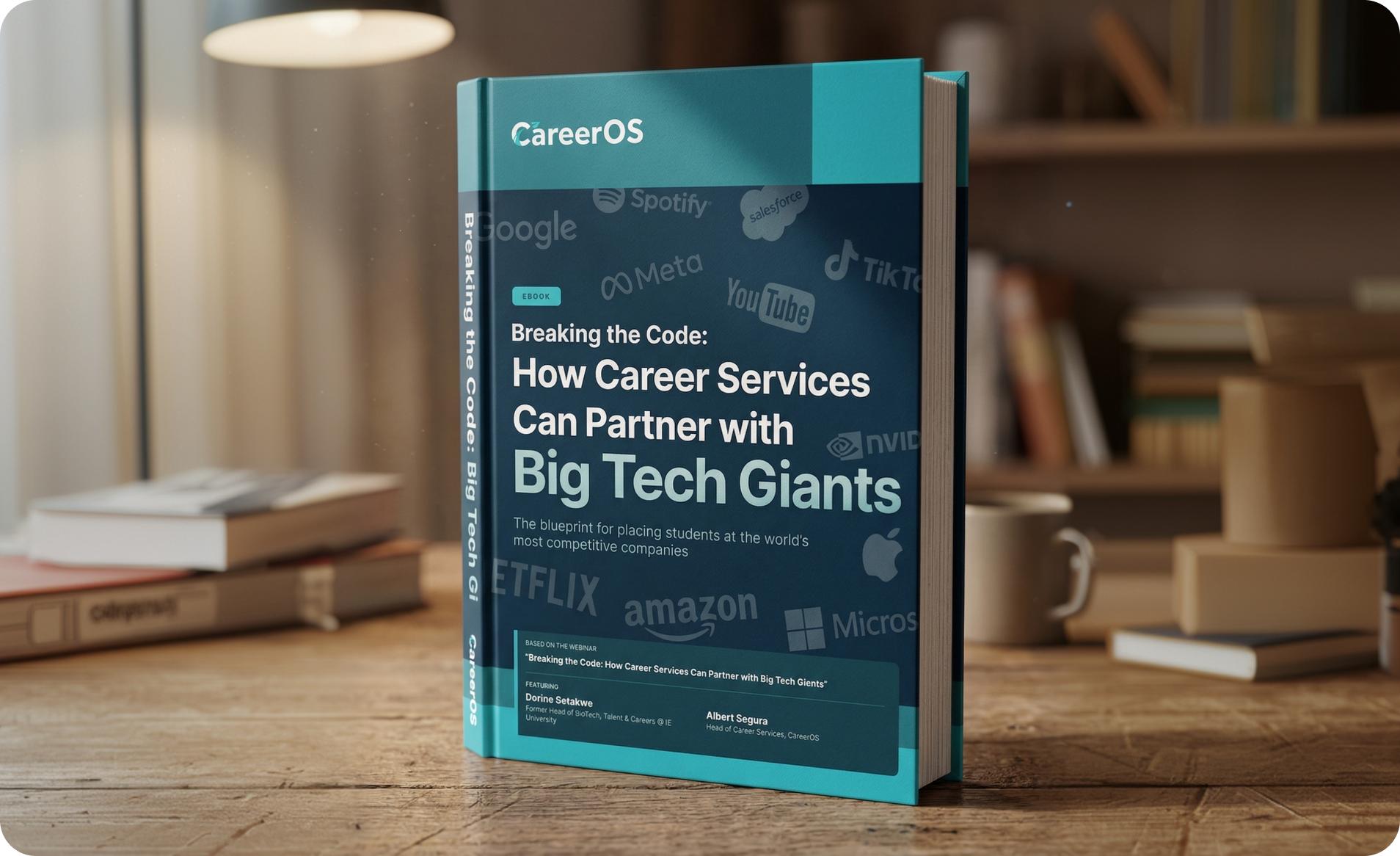
We turned that conversation into an ebook. Here's a taste of what's in it.
The problem isn't your students. It's your positioning.
One of the most uncomfortable truths Dorine shared during the session: Big Tech companies often don't respond to career services outreach not because they're not interested in your students, but because your pitch doesn't speak their language.
Most outreach sounds like this: "Hi, we're [University], we have great students, would love to connect." From a recruiter's inbox — where that message arrives a dozen times a week from a dozen different schools — it lands with all the impact of a flyer under a windshield wiper.
What actually gets a response is specificity. It's knowing that the company you're targeting just announced a major expansion of their data engineering team, and reaching out with a proposition that connects directly to that. It's referencing the specific programme, the specific skills, the specific stage the company is at. It's sounding less like a career office and more like someone who has done their homework.
The shift Dorine describes isn't cosmetic. It's a fundamentally different way of thinking about what you are and what you offer. Not a middleman between students and employers. A strategic partner who helps companies solve talent problems.
The alumni network is the most underused asset in career services
Ask Dorine how she got her foot in the door at the companies she eventually built deep relationships with, and the answer is almost always the same: alumni.
Not cold outreach. Not career fair booths. Not LinkedIn connection requests to strangers. Alumni. People who had already walked the path from the university to the company and could make an introduction, answer questions about the culture, or simply put a face to the name.
This sounds obvious. And yet most career services teams treat their alumni network as a passive resource — something that exists, somewhere, in a database that hasn't been updated since 2019. The institutions that are winning the Big Tech game have flipped this: they treat their alumni as active intelligence sources and relationship bridges, mapping them systematically and reaching out with real asks, not generic newsletter subscriptions.
In the ebook, we walk through exactly how to do this — including the specific things worth asking alumni for beyond the obvious.
Persistence isn't a personality trait. It's a system.
One of the most memorable moments of the webinar came near the end, when Dorine was asked what she'd say to career advisors who feel stuck, frustrated, or like they're talking to a brick wall when it comes to Big Tech.
Her answer was simple: keep going.
Not in a motivational-poster way. In a practical, tactical, "here is what to do when one person doesn't respond" way. You find another person. You try a different angle. You reach out six months later when the hiring cycle shifts. You attend the event where that company sends a speaker and you introduce yourself in person.
She was direct about the fact that she got ignored. A lot. And that every relationship she eventually built started somewhere that didn't look promising — a cold message that got forwarded internally, a chance conversation at a conference, an alumnus who happened to reply.
The career services professionals who build Big Tech partnerships aren't the ones with the most impressive universities or the best students. They're the ones who don't take silence personally and don't stop knocking on doors.
What makes this ebook different from every other "employer engagement" resource out there
Honestly? Most content in the career services space is either too generic to be useful or too theoretical to be actionable. It tells you to "build strategic relationships" without telling you what to say in the first message. It tells you to "understand employer needs" without telling you where to find that information. It gestures at best practices from institutions you can't relate to.
This ebook is built differently because it comes from a real conversation with someone who has been on both sides of the table — as a tech recruiter and as a career services leader. Dorine's advice is specific because it comes from specific experience. When she says "look at the job descriptions carefully before you reach out," she means it in the way that someone means it when they've seen hundreds of university pitches land flat because the person sending them hadn't done that.
The ebook covers ten chapters, from understanding why Big Tech actually needs you (the answer might surprise you) to designing events that employers actually want to attend, to preparing STEM students for the specific rigours of Big Tech hiring processes. It closes with a Quick Wins checklist: ten things you can do this week to start moving in the right direction.
It's 16 pages. It's free. And if you work in career services and you're not landing your students at the companies you know they're capable of joining, it's probably the most useful thing you'll read this month.