
The New Rules of Hiring Are Here, And Most Students Aren’t Prepared for Them
Applications are easier than ever.
Landing the job? That’s the hard part.
Students today can apply to hundreds of roles in just a few clicks. LinkedIn’s Easy Apply, AI-generated resumes, automated cover letters, and endless job boards have completely transformed the application process.
But here’s the reality employers are seeing on the other side:
Thousands of applications.
Generic resumes.
Mass outreach.
Candidates who all look the same.
The modern hiring market has become incredibly noisy — and students are struggling to stand out.
For career advisors and universities, this creates a new challenge.
The old playbook isn’t enough anymore.
Helping students succeed today requires more than resume reviews and job boards. Students now need guidance on networking, personal branding, strategic outreach, AI literacy, storytelling, and international hiring dynamics.
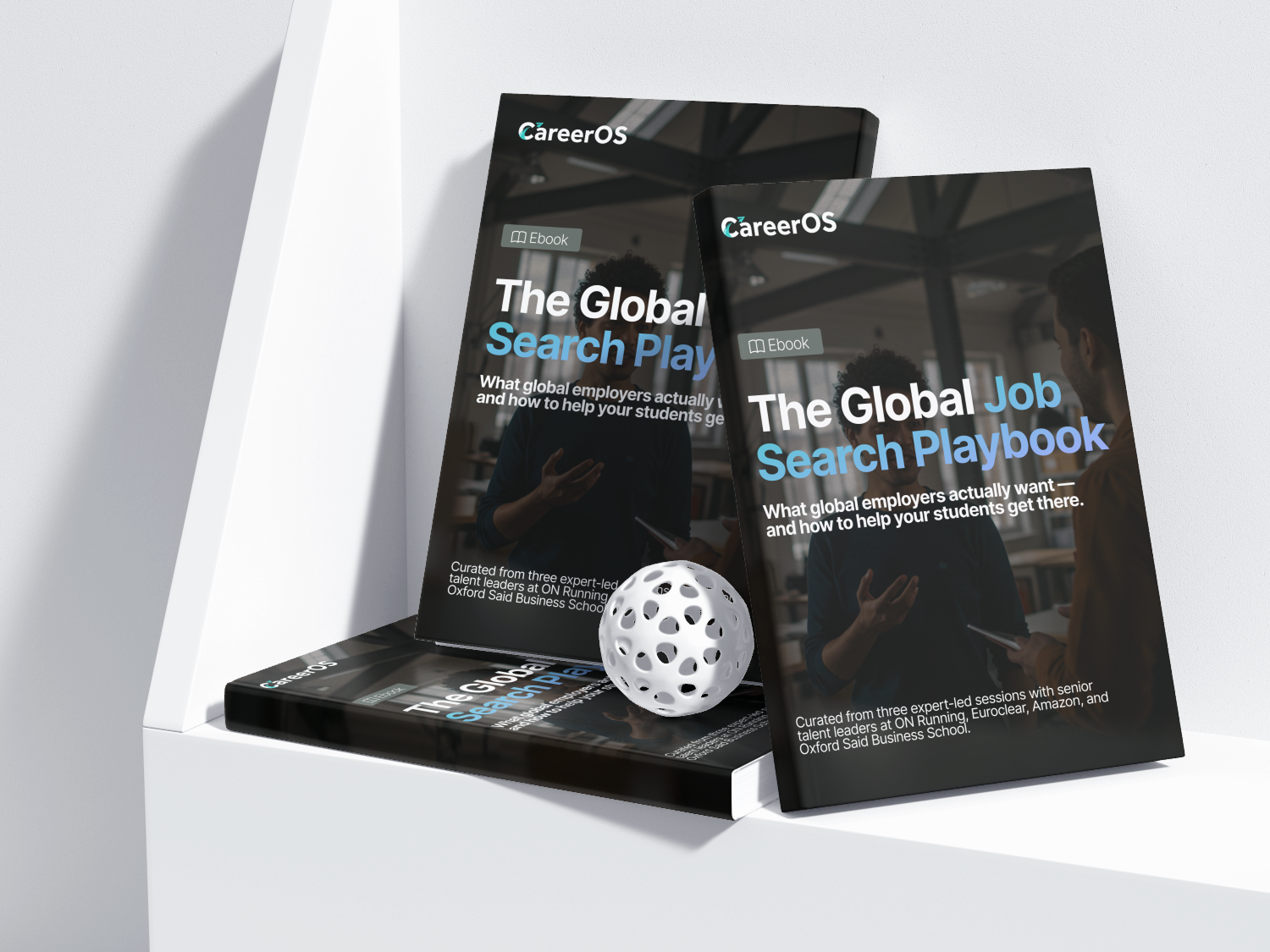
That’s exactly why we created The Global Job Search Playbook.
A new free ebook from CareerOS designed specifically for career advisors, employability teams, and universities supporting students in competitive global hiring markets.
The ebook combines insights from senior talent leaders at:
- ON Running
- Euroclear
- Amazon
- Oxford Saïd Business School
…to unpack what employers are actually looking for today — and how universities can better prepare students for modern recruitment.
Hiring Has Changed Faster Than Career Support Models
One of the biggest misconceptions students have today is believing the hiring process is primarily about submitting applications.
It’s not.
Most successful candidates are:
- Building relationships before roles open
- Positioning themselves strategically
- Getting referrals
- Tailoring applications deeply
- Understanding hiring systems
- Practicing storytelling long before interviews begin
And employers know it.
In fact, one of the strongest themes throughout our conversations with recruiters was this:
The strongest candidates are intentional candidates.
Not necessarily the smartest.
Not necessarily the most experienced.
But the most strategic.
Students who understand how modern hiring works gain a massive advantage.
The problem?
Most students were never taught how hiring actually works behind the scenes.
AI Is Changing Recruitment — But Not How Students Think
AI is one of the biggest transformations happening in recruitment today.
Applicant Tracking Systems (ATS), resume scanners, automated rankings, AI-assisted screening tools — these systems now shape the earliest stages of hiring.
But contrary to what many students believe:
AI is not replacing recruiters.
Recruiters still make the final decisions.
Humans still assess storytelling, communication, fit, motivation, and potential.
What AI does change is the first layer of visibility.
Students now need resumes that:
- Align with job descriptions
- Use relevant language naturally
- Communicate value clearly
- Remain readable to both algorithms and humans
In the ebook, Kirsten Pilar — Senior Global Talent Acquisition Leader at ON Running — explains how recruiters are balancing AI tools with human judgment and why generic resumes are becoming increasingly ineffective.
For career advisors, this creates a huge opportunity:
Helping students understand not just what to apply to, but how modern hiring systems evaluate them.
International Students Need a Different Strategy
Another major theme from the ebook is something universities are discussing more than ever:
International employability.
For international students, the challenge is often bigger than qualifications alone.
They face:
- Visa concerns
- Cultural differences
- Different networking norms
- Uncertainty around employer sponsorship
- Limited understanding of local recruitment cycles
But there’s also good news.
Employers increasingly value international experience when students position it correctly.
Adaptability.
Cross-cultural collaboration.
Resilience.
Communication.
Global perspective.
These are not disadvantages.
They’re career assets.
In the ebook, Jorn — Global Head of Campus Recruitment at Euroclear — shares practical guidance on how students should position international backgrounds strategically instead of defensively.
This is especially relevant for career centers supporting:
- MBA programs
- International cohorts
- Masters students
- Exchange programs
- Globally mobile talent
Networking Is No Longer Optional
Perhaps the biggest shift in the hiring market is this:
Networking has moved from “nice-to-have” to essential.
The strongest candidates are not waiting passively for responses.
They are:
- Reaching out to alumni
- Building relationships early
- Scheduling informational conversations
- Following up consistently
- Creating internal advocates before interviews happen
And employers notice.
One recruiter featured in the ebook explained how referrals and internal recommendations often push candidates into interview pipelines — even when algorithms initially overlooked them.
This changes the role of career services dramatically.
Career advising is no longer just about helping students apply.
It’s about teaching students:
- How to build professional relationships
- How to communicate professionally
- How to network authentically
- How to stay organized throughout long hiring cycles
That’s one of the reasons CareerOS was built in the first place:
To help students move beyond passive applications and toward proactive career execution.
Interview Preparation Needs to Start Earlier
Another major insight from the ebook:
Students are preparing too late.
By the time interviews arrive, most candidates are scrambling:
- Trying to build STAR stories
- Researching companies overnight
- Learning behavioral interviewing
- Clarifying their narrative under pressure
Top candidates don’t prepare days before interviews.
They prepare months before.
Tom Lawrence — former Head of MBA Recruitment at Amazon and former Head of Global Industry Careers at Oxford Saïd — shares practical frameworks for helping students:
- Build stronger career stories
- Answer behavioral questions effectively
- Prepare for assessment centers
- Communicate with clarity and confidence
One of the most powerful reminders from the ebook:
Specificity wins every time.
Students who communicate concrete examples, measurable impact, and intentional career decisions consistently stand out.
Why This Matters for Universities
Universities are under growing pressure to demonstrate employability outcomes.
Students expect career support that feels:
- Modern
- Personalized
- Practical
- Industry-aligned
- Tech-enabled
At the same time, career services teams are stretched thin.
That’s why scalable systems matter more than ever. CareerOS was designed to help universities support students with networking tools, AI-powered career guidance, application tracking, and employability workflows in one centralized platform.
The goal isn’t to replace advisors.
It’s to amplify them.
Because students still need human support.
Human confidence.
Human coaching.
Technology simply helps scale that support more effectively.
What You’ll Find Inside the Ebook
Inside The Global Job Search Playbook, you’ll discover:
- How recruiters actually use AI
- What global employers value most
- Networking strategies students should prioritize
- International hiring insights
- Interview preparation frameworks
- Advisor-specific coaching takeaways
- Practical recommendations universities can apply immediately
Whether you support undergraduate students, MBAs, international cohorts, or executive education participants, this ebook is designed to give career teams actionable insights they can immediately use in advising sessions, workshops, and employability programming.
Final Thought
The students who succeed today are not necessarily the ones submitting the most applications.
They’re the ones who:
- Build relationships intentionally
- Understand how hiring works
- Position themselves strategically
- Communicate clearly
- Prepare consistently
And behind many of those students? A career advisor who taught them how.
Download The Global Job Search Playbook and help your students navigate the new rules of hiring.